Guide · 14 October 2026 · Ferrari Ceramic Coating Manchester
Ceramic Coating vs Paint Protection Film: Ferrari Guide
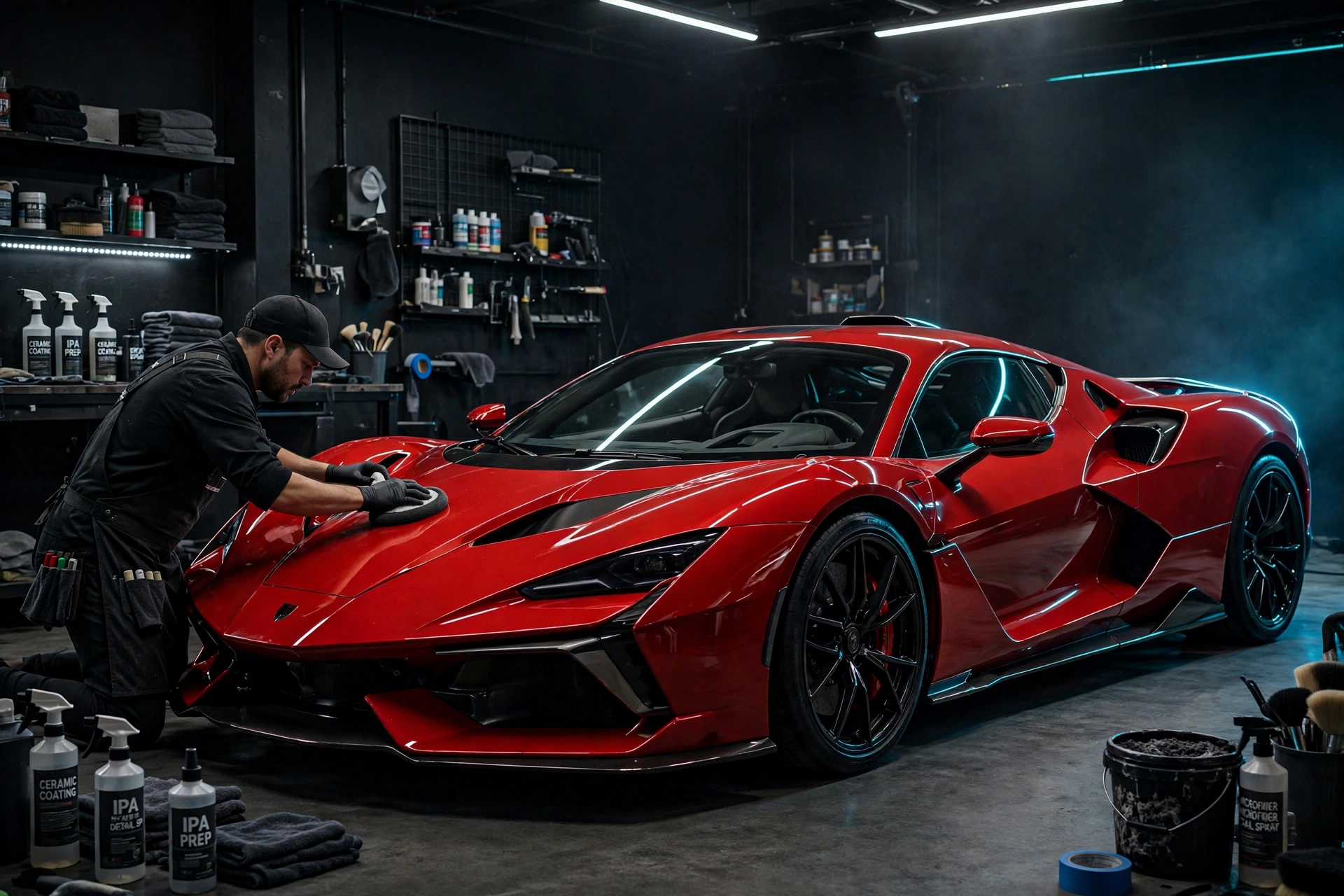
The honest answer is that ceramic coating and paint protection film do different jobs: coating gives chemical protection, gloss and easier washing, while PPF gives physical defence against stone chips and scratches. If chips worry you most, choose PPF; if gloss and maintenance matter most, choose coating. Most Ferrari owners choose both — PPF on impact zones, coating over everything.
Ask any Ferrari owners' forum whether to choose ceramic coating or paint protection film and you will get a war. Both camps are right about their own product and wrong about the other's, because the two do fundamentally different jobs. This guide is the honest head-to-head we wish every customer read before spending a penny: what each product is, what each protects against, what each costs on a Ferrari, and why so many owners end up choosing both.
Written by a Manchester specialist who applies both products to supercars, this comparison covers protection, durability, cost, appearance and maintenance across six dimensions, then gives you a straight verdict for different types of Ferrari owner — the daily driver, the weekend car, the concours enthusiast and the track-day regular. No product to push, no affiliate links: just the trade-offs as they actually are.
What each product actually is
Ceramic coating is a liquid — usually silicon dioxide — that is applied to corrected paintwork and cures into a thin, glass-like layer chemically bonded to the clear coat. It is measured in microns and adds hardness, hydrophobics and gloss, but almost no physical thickness. Paint protection film is the opposite approach: a thick, self-healing polyurethane film, typically around 150–200 microns, that is wrapped onto panels and physically absorbs stone chips, scratches and scuffs. One is chemistry; the other is armour.
Head-to-head: coating vs PPF across six dimensions
Here is how the two compare on the factors that actually matter to Ferrari owners — the daily driver doing M60 miles, the weekend car, and the concours enthusiast all weigh these six dimensions differently, but the underlying trade-offs are the same for every Ferrari.
- Stone-chip protection: PPF wins decisively — it physically absorbs impacts. Coating offers essentially none.
- Gloss and appearance: coating wins — it adds depth and wetness PPF cannot quite match, though modern films are close.
- Chemical and UV resistance: coating wins — stronger barrier against bird lime, sap, fallout and sun.
- Ease of washing: coating wins — superior hydrophobics mean dirt releases faster.
- Durability: PPF typically lasts longer (often 7–10 years) versus 2–5 years for most coatings.
- Cost on a Ferrari: full-car PPF usually costs several times a coating package — both vary hugely with paint condition and coverage.
What each costs on a Ferrari — honest market guidance
Neither product has a fixed price, and any guide quoting exact figures should be treated with suspicion. As a rough UK market guide, professional ceramic coating packages for Ferraris commonly sit in the low-to-mid four figures including paint correction, while full-car PPF commonly runs into five figures — often several times the cost of coating. Partial PPF (front bumper, bonnet, mirrors, sills) narrows the gap considerably. Always get itemised quotes for both, and request a free quote from us for an honest assessment of what your car actually needs.
The hybrid approach most Ferrari owners choose
You do not have to pick one. The most popular setup we see on Ferraris is PPF on the impact zones — front bumper, bonnet leading edge, wings, mirrors and sills — with ceramic coating applied over the entire car, including over the film. You get physical chip defence where it matters, plus the gloss, hydrophobics and chemical resistance of a coating everywhere. It costs more than coating alone and less than full-car PPF, and for most owners it is the sweet spot.
Keep reading
Serving Manchester & Greater Manchester
Around Manchester, the coating-vs-PPF decision often comes down to how you drive: M60 commuters and Cheshire-lane regulars face real stone-chip risk and lean towards PPF on the front end, while garaged weekend cars in Didsbury, Chorlton or Bowdon usually get more from a coating's gloss and easy washing. We fit and apply both across Greater Manchester. Request a free quote and we will recommend the honest split for your Ferrari — including the hybrid most owners choose.
Areas we serve
ManchesterSalfordStockportAltrinchamTraffordBuryOldhamWigan
Ferrari ceramic coating across Manchester & Greater Manchester — Manchester service area →
Frequently asked questions
Can you apply ceramic coating over paint protection film?
Which lasts longer, ceramic coating or PPF?
Does PPF change how my Ferrari looks?
Is PPF worth it on a Ferrari that is rarely driven?
Can PPF be removed without damaging Ferrari paint?
Get your free, no-obligation quote
Tell us which Ferrari you drive and what it needs. We'll reply with an exact price and the earliest available slot.